
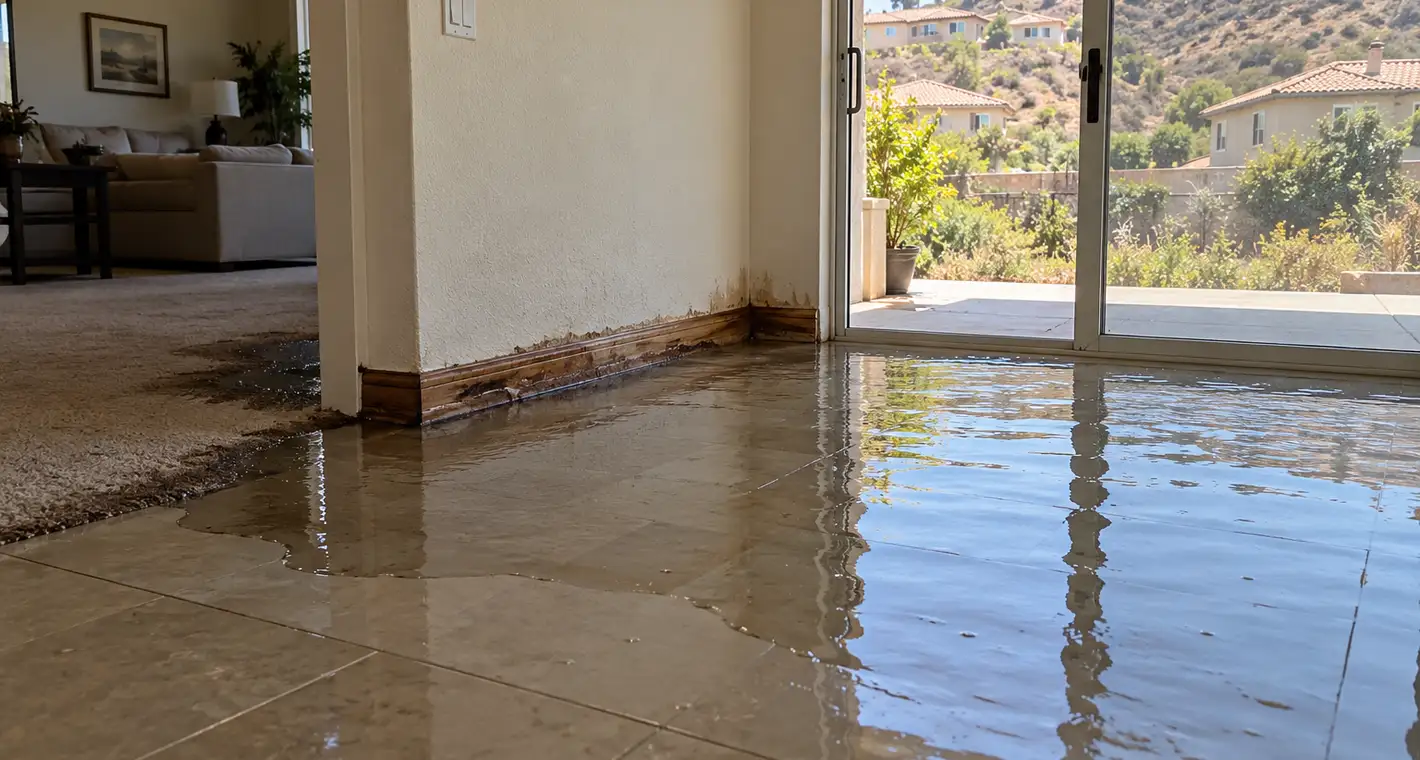
Emergency water removal Laguna Hills on a sloping lot
Laguna Hills lies inland between Aliso Creek and the ridge that separates it from the coast, wrapped around the interchange of the freeway and Alicia Parkway. The northeast half rises into the horse country of Nellie Gail Ranch, where lots run to half an acre on slopes rather than pads. The city is split almost evenly between two decades: 39 percent of its homes were built in the 1970s and 35 percent in the 1980s, with a median year of 1980. The older tracts are compact single-story slab houses; the Nellie Gail side is larger two-story custom construction on graded hillside lots.
Before help arrives
- Shut the water off at the fixture or the main if you can reach it safely.
- Keep out of any room where water has reached outlets, cords, or the electrical panel.
- Lift furniture off wet carpet and move what you can to a dry floor.
- Photograph the damage and the failure point before anything is moved.
- Do not use a household vacuum to pick up standing water.
Burst pipe cleanup Laguna Hills: two housing types, two failures
Irrigation on a half-acre slope
Nellie Gail lots carry a lot of landscape and a lot of buried irrigation. A cracked lateral or a stuck valve puts hundreds of gallons a day into the hillside without anything showing at the surface. The water finds the downhill wall of the house or the garage slab, and the symptom reads exactly like a plumbing leak until somebody shuts the irrigation off and watches the meter.
1970s copper in the older tracts
The compact tracts near the freeway are the same vintage as the older phases of Mission Viejo. The same copper is now the same age. In a single-story slab house a pinhole under the floor has nowhere to go but sideways. It shows up as warm tile, damp carpet at the edge of a room, or a bill that has quietly doubled.
Hard water on tanks and connectors
Water in this district is hard, and hardness works on the water heater first. Scale settling in the tank drives the burner harder and shortens the life of the tank, then the tank goes at the seam. The same water stiffens braided connector hoses and toilet supply lines, which are the least expensive parts in the house and the most common failure in it.
Retaining walls with blocked subdrains
Hillside lots here are terraced behind retaining walls, and every one of those walls was built with a drain behind it. Those drains silt up. When the outlet stops flowing, the wall holds back saturated soil instead of draining it. Water comes through the wall stem into whatever is behind it. Often that is a garage or a finished room.
Ceiling leak repair Laguna Hills in two-story hillside homes
Two housing types mean two different jobs. Small single-story slab homes dry quickly once the pad is out and the wall base is open. The large hillside houses have long runs, more bathrooms and often a finished lower level cut into the slope, where water collects against a retaining wall that was never meant to be an interior surface.
The order of work does not change: extraction, then air movers and dehumidifiers together, with readings logged daily. It is set out on the water extraction and drying page.
Mold remediation Laguna Hills behind a retaining wall
On the large lots, the recurring find is growth in a wall that backs onto a retaining wall or a planter. The wall assembly there has been damp every winter for years and nobody noticed until a plumbing leak added to it. Mold remediation is a separate scope of work with containment and controlled removal, and a slab leak that ran for weeks is the usual reason it is needed.
Services available in Laguna Hills
- Water Extraction & DryingStanding water removal and controlled structural drying under moisture readings.
- Slab Leak Damage RepairWater surfacing through a post-tension or conventional slab, traced and dried out.
- Sewage CleanupContaminated water handled with containment, removal and cleaning.
- Mold RemediationGrowth that established after water sat longer than it should have.
Areas covered across Laguna Hills
Providers cover Laguna Hills and the surrounding area, including Nellie Gail Ranch, Moulton Ranch, Aliso Meadows, Village Pointe, Sheffield and Valencia.
ZIP codes: 92653.
Water damage restoration Laguna Hills: common questions
- There is water in the garage after every storm. Is that a plumbing problem?
- Usually not. On sloping lots the garage is the low point of the pad, and water that should be caught by a swale or an area drain arrives at the slab edge instead. Look at where the water enters before assuming a pipe. If it appears during dry weather as well, then the supply side is worth testing.
- Does a horse property change the restoration work?
- Not inside the house. What it changes is the water use around it. Stalls, wash racks and long irrigation runs mean more buried line under the property, and more places where a slow leak can run for weeks. Providers dry the structure; locating the source on that much acreage sometimes takes a leak detection specialist.
- My house is single story on a slab. Where does water hide?
- Under the pad, along the tack strip, inside the bottom sixteen inches of drywall, and in the sill plate. None of that is visible from the room. The floor can feel dry while the wall base is holding water, so readings are taken at the base of every wall in the affected room rather than only where the stain is.
- How do I tell an irrigation leak from a plumbing leak?
- Shut off the irrigation controller at the panel and leave it off for a full day, then read the meter at the start and the end of that day with the house quiet. If the meter still moves, the water is coming from the domestic side. If it stops, the problem is in the landscape and the fix is a sprinkler contractor rather than a plumber. The drying of whatever got wet is the same either way.