
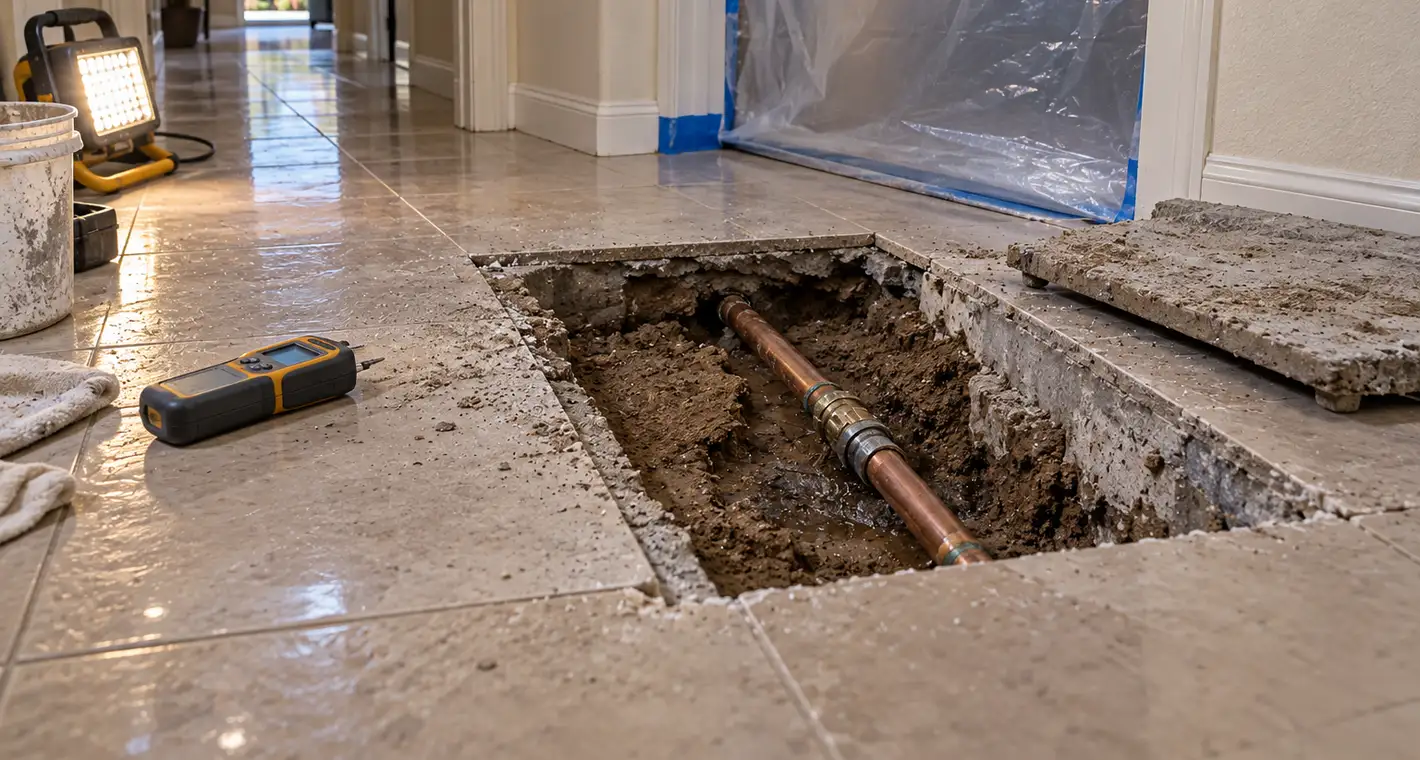
Why slab leaks are the regional failure here
California has basements in roughly five percent of its housing stock, and almost none of that five percent is in this county. Houses here sit on concrete poured over a graded pad, with supply lines either cast into the slab or run beneath it. That single construction choice decides what a plumbing failure looks like: there is no lower level for water to collect in and nothing to pump out, so water leaves the pipe, works up through the slab, and moves sideways under the flooring.
The second factor is age. Median year built runs from 1964 in Laguna Beach through 1979 in Mission Viejo and San Juan Capistrano to 1986 in Laguna Niguel, which places most of the housing stock in the decades when copper was the standard supply material. Hard imported water pits that copper from the inside while soil chemistry works on the outside, and the hot line, which runs warmer and moves faster, reaches a pinhole first.
Copper pinhole leaks and what they look like from inside the house
Warm floor, cold season
A patch of tile or vinyl that stays warm when nothing is running sits over a leaking hot line. It is the earliest and clearest indicator, and it often appears months before any moisture is visible.
A meter that will not stop
With every fixture in the house closed, the meter should be still. If the low-flow indicator keeps turning, water is leaving the pressurized side somewhere, and under a slab is the place it hides longest.
Damp with no source above
Carpet that stays wet at one edge of a room, grout that darkens along a line, or baseboard that swells with no plumbing in the wall above it. Water arriving from below reaches the wall base first because that is where the slab meets the framing.
Pressure that faded
A gradual drop at fixtures on one side of the house points at a line losing volume before it opens fully. In houses still on galvanized steel, in Laguna Beach and older San Clemente, the same symptom means the pipe is closing with corrosion rather than leaking.
Locating it before anything is opened
Nothing gets cut until the leak is located. Pressure testing isolates the hot and cold sides, acoustic equipment picks up the sound of water escaping through the slab, and thermal imaging maps the warm path of a hot line. Tracer gas is used where the slab is thick or the flooring makes listening difficult.
That work belongs to a plumber or a leak detection specialist. Restoration adds the moisture map: how far the water has already spread through the slab, the tack strip and the wall base, which is nearly always farther than the wet spot on the floor suggests.
Repair in place or reroute overhead
Where the failure is isolated and the rest of the piping is sound, the slab is opened at the leak, the section replaced and the concrete patched. Where the pipe is at the age when the next pinhole is a question of months, rerouting is common here: the run is abandoned in the slab and a new line carried overhead through the attic and down inside walls. Which approach fits depends on the material, its age and how many failures the house has had, and it is a decision for the homeowner and the plumber rather than the restoration provider.
Drying a slab after the leak is stopped
Concrete gives water up slowly, so a slab wet for weeks does not dry in the two or three days a burst line above the floor would take. Flooring comes up where it traps moisture underneath: carpet pad almost always, engineered wood and laminate most of the time. Tile in thinset often stays.
Air movers are directed along the slab and at the base of affected walls, with dehumidifiers removing what evaporates. Where water reached the bottom plate, the cavity is dried through small openings at the base or by taking out a band of drywall. Readings are logged daily until they match unaffected material of the same kind in the same house.
Slab leak repair South Orange County: cities covered
- Slab Leak Repair Laguna NiguelZIP 92677, 92607
- Water Damage Restoration Mission ViejoZIP 92691, 92692
- Water Damage Restoration Aliso ViejoZIP 92656
- Water Damage Restoration Laguna HillsZIP 92653
- Water Damage Restoration Lake ForestZIP 92630, 92610
- Water Damage Restoration San Juan CapistranoZIP 92675
- Water Damage Restoration Dana PointZIP 92629, 92624
- Water Damage Restoration San ClementeZIP 92672, 92673, 92674
- Water Damage Restoration Rancho Santa MargaritaZIP 92688
- Water Damage Restoration Laguna BeachZIP 92651, 92652
- Water Damage Restoration Ladera RanchZIP 92694
- Water Damage Restoration Coto de CazaZIP 92679
Slab leak repair South Orange County: common questions
- What does a slab leak feel like before it is visible?
- A warm patch of floor with nothing running is the most reliable sign, because the hot line fails first. Others include a water meter that keeps moving with every fixture closed, a faint sound of running water under the floor at night, a drop in pressure at fixtures on one side of the house, and carpet or tile that stays damp in one place. Any of them justifies a meter test before the drywall is involved.
- Why do copper lines under a slab fail here at all?
- Two things work on them at once. Imported water in this region is hard, and dissolved minerals pit the inside of the pipe wall. Soil chemistry and any stray electrical current work on the outside. A copper line that would give seventy years in soft water commonly starts opening pinholes at thirty to forty in Southern California, which is exactly the age of the housing across these cities.
- Is polybutylene still a problem in this area?
- In tracts finished between the late 1970s and the mid-1990s, yes, if the house has never been repiped. Polybutylene supply piping was installed nationally through that window, and the Cox v. Shell settlement approved in November 1995 funded replumbing for more than 320,000 homes before claims closed in 2009. Houses that never filed still have the original pipe, and it fails by splitting rather than by weeping.
- Does insurance pay for a slab leak?
- Policies vary and the distinction usually drawn is between the damage and the pipe. Sudden and accidental water damage caused by a failed line is commonly covered, including the cost of opening and closing the slab to reach it, while the pipe repair itself and any long-term seepage often are not. Report the loss promptly, photograph everything before work starts, and keep the failed section of pipe.
- How long does a house take to dry after a slab leak?
- Longer than an equivalent loss above the floor. Concrete releases moisture slowly, and the water has usually been in the assembly for weeks before anyone noticed. Five to seven days of controlled drying is common, with readings taken at the slab surface, the wall base and the framing until they match unaffected material of the same type elsewhere in the house.