
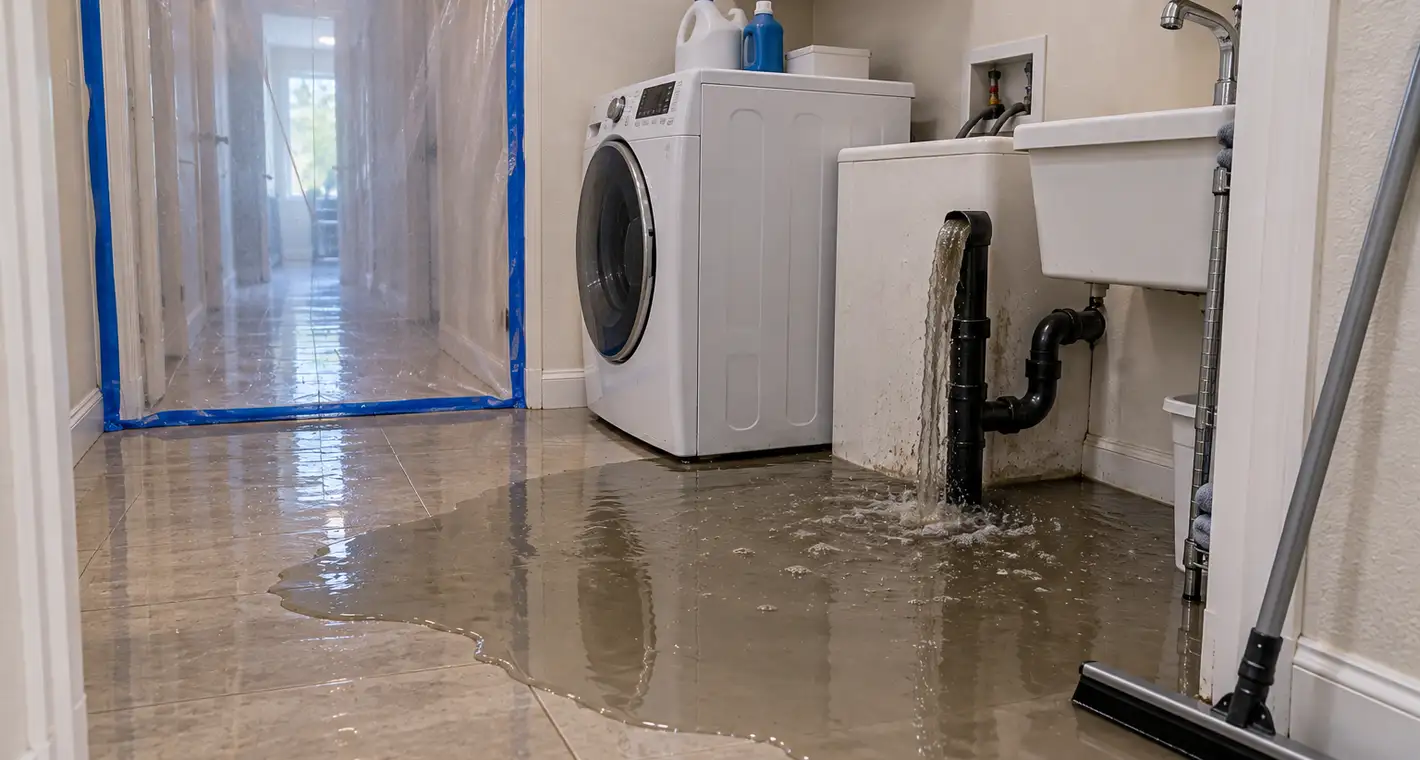
Keep out of the affected area
- Keep children and pets away from the area entirely.
- Do not run fans in the space. Moving air spreads contamination through the house.
- Do not attempt to extract it with household equipment.
- Avoid using drains and fixtures on that line until the cause is identified.
- Photograph the extent before anything is moved.
Sewage backup cleanup is a different job from a clean-water loss
With clean water, the problem is moisture and the goal is to get materials back to normal. With sewage, moisture is the secondary issue. The water carries bacteria and organic material that soak into porous surfaces and stay there after the water is gone. Extracting and drying a carpet that has been through a sewage backup returns it to normal moisture while leaving the contamination in place.
That single fact drives the whole approach. Rather than asking what can be dried, the work asks what can be cleaned all the way through. Material that can only be cleaned on the surface comes out.
How the work proceeds
The area is contained before anything is removed. Openings to the rest of the house are sheeted off and the work zone is put under negative pressure, so air flows into it and is filtered on the way out rather than carrying contamination into clean parts of the home. Skipping this step means the removal itself distributes the problem.
Affected porous material is then removed and bagged. That typically means carpet and padding, the lower band of drywall, wet insulation, particleboard, and laminate or engineered flooring. Non-porous material such as concrete, tile, sealed hardwood and structural framing can usually be cleaned and kept, since contamination stays on the surface where it can be reached.
Cleaning follows removal, and only after cleaning does the structure get dried in the ordinary way, with air movers and dehumidification under moisture readings. Drying before cleaning would set contamination into the materials being dried.
Where these losses come from in South Orange County
Cast iron and clay laterals in the older streets
Laguna Beach and the southwest end of San Clemente still have laterals laid before 1960 in cast iron or vitrified clay. Both fail at the joints, and roots from the mature trees along those streets find the opening. The first symptom is a tub or shower that drains slowly, not a backup.
Pumped sewers on hillside terrain
Nothing here drains to a treatment plant by gravity alone. Moulton Niguel Water District alone runs about 500 miles of wastewater pipeline and 17 lift stations across these cities. A pump failure or a force main break puts the flow somewhere it was not meant to go, and in January 2025 one such failure released more than half a million gallons near Laguna Niguel Regional Park.
Winter storms loading the system at once
Rain here arrives in a few large events rather than steadily. Water enters older sewer lines through cracked joints and manholes during those storms, and the added flow surcharges the line. In a slab-on-grade house the backup appears at the drain closest to the floor, usually a ground-floor shower or a laundry standpipe.
Sewage cleanup Laguna Niguel and nearby cities
- Slab Leak Repair Laguna NiguelZIP 92677, 92607
- Water Damage Restoration Mission ViejoZIP 92691, 92692
- Water Damage Restoration Aliso ViejoZIP 92656
- Water Damage Restoration Laguna HillsZIP 92653
- Water Damage Restoration Lake ForestZIP 92630, 92610
- Water Damage Restoration San Juan CapistranoZIP 92675
- Water Damage Restoration Dana PointZIP 92629, 92624
- Water Damage Restoration San ClementeZIP 92672, 92673, 92674
- Water Damage Restoration Rancho Santa MargaritaZIP 92688
- Water Damage Restoration Laguna BeachZIP 92651, 92652
- Water Damage Restoration Ladera RanchZIP 92694
- Water Damage Restoration Coto de CazaZIP 92679
Sewage cleanup Laguna Niguel: common questions
- Why can sewage water not simply be extracted and dried?
- Because the concern is contamination rather than moisture. Water from a sewer backup carries bacteria and organic material that remain in porous surfaces after the water itself is gone. Drying a saturated carpet returns it to normal moisture but does nothing about what soaked into it, which is why porous material affected by sewage is removed rather than dried.
- What has to be removed after a sewage backup?
- Generally carpet and padding, the lower band of drywall, wet insulation, particleboard and any laminate or engineered flooring the water reached. Non-porous surfaces such as concrete, tile, sealed hardwood and framing can usually be cleaned and kept. The dividing line is whether the material can be cleaned all the way through or only on the surface.
- Is a backup from a clean toilet treated the same way?
- Water from a toilet overflow that has not passed the trap is a lesser category and is handled less aggressively. Once water has come back up from the lateral or the main, or has passed through the trap, it is treated as contaminated regardless of how it looks or smells. Describe what actually happened when you call, since the two get very different responses.
- How is the rest of the house kept clean during the work?
- The affected area is contained before removal starts, usually with sheeting over openings and negative air pressure inside the work zone so air flows into it rather than out into the rest of the home. Material comes out bagged. Without containment, the removal itself distributes contamination through the house.
- How old is the sewer lateral under a South Orange County house?
- It is as old as the house, and the house is anywhere from a hundred years old in Laguna Beach to twenty in Ladera Ranch. Pre-1970 laterals in the coastal streets are cast iron or vitrified clay, both of which crack at the joints and admit roots. Tracts from the 1970s and 1980s are usually ABS plastic, which is far more durable but breaks where the ground has settled. The lateral from the house to the main is the homeowner's responsibility in most of these cities.