
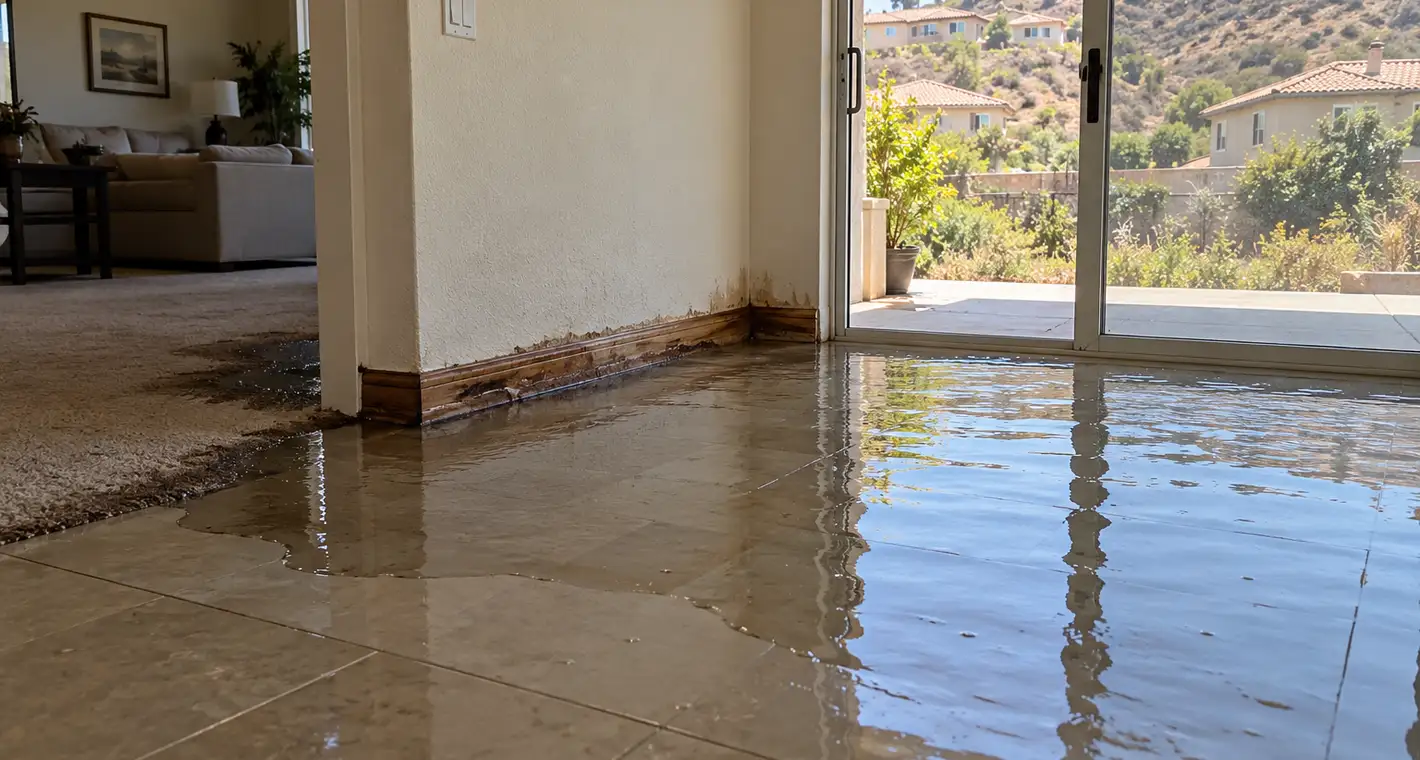
Emergency water removal San Juan Capistrano on the valley floor
The city sits about three miles inland where San Juan Creek and Arroyo Trabuco meet, with Horno and Oso creeks joining from the north. The valley floor is flat and low; the tracts on Mission Hills and above Ortega Highway climb several hundred feet out of it in under a mile. Thirty-six percent of the housing stock was built in the 1970s and the median year is 1979. The range is unusually wide, though. The Los Rios district holds some of the oldest continuously occupied houses in California, and hillside subdivisions were still going up in the 2000s.
Before help arrives
- Shut the water off at the fixture or the main if you can reach it safely.
- Keep out of any room where water has reached outlets, cords, or the electrical panel.
- Lift furniture off wet carpet and move what you can to a dry floor.
- Photograph the damage and the failure point before anything is moved.
- Do not use a household vacuum to pick up standing water.
Burst pipe cleanup San Juan Capistrano in the 1970s tracts
The creek floodplain and its levees
The city has taken part in the National Flood Insurance Program since 1978, and properties along San Juan, Trabuco, Horno and Oso creeks sit inside mapped flood zones. The Army Corps has judged several of the levees here inadequate for a hundred-year event, and a December 2010 storm damaged them badly enough to raise the question again. Storm water that reaches a house is category three from the first minute.
1970s plumbing in the valley tracts
The tracts built along the flat ground in the 1970s are on their original copper. It is now the age at which pinholes start. These houses sit on slabs at grade, with a high water table nearby in winter. A leak under the floor stays wet longer than it would on a hillside pad. The first sign is often mildew odor rather than a stain.
Runoff off the ridges after a dry autumn
The hillside neighborhoods drop steeply toward the valley, and the first real rain after a dry summer runs off hard soil rather than soaking into it. Where a lot drain or a street inlet is blocked with the season's debris, the sheet flow goes around it and downhill until something stops it. That is usually a garage door, or a side gate at the bottom of a driveway.
Older structures with modern plumbing added
Downtown and around Los Rios there are buildings whose plumbing has been replaced two or three times inside walls that were never designed to carry it. A leak inside an adobe or an early wood-frame wall spreads into materials that hold water for a long time and cannot be dried the way gypsum board is dried. These jobs are slower and need moisture readings taken more carefully.
Ceiling leak repair San Juan Capistrano in two-story hillside homes
Losses on the valley floor often involve water that came from outside, which changes the category and usually means more material is removed rather than dried. Hillside homes take clean water from failed supply lines and dry conventionally. In the older adobe and wood-frame buildings downtown, drying is slower and gentler because the materials cannot take aggressive airflow.
The order of work does not change: extraction, then air movers and dehumidifiers together, with readings logged daily. It is set out on the water extraction and drying page.
Mold remediation San Juan Capistrano after storm water
Ground floor rooms on the valley side are the ones to watch. A wall that took storm water at the base once has usually taken it more than once, and growth found there is generally older than the leak that prompted the call. Mold remediation is a separate scope of work with containment and controlled removal, and a slab leak that ran for weeks is the usual reason it is needed.
Services available in San Juan Capistrano
- Water Extraction & DryingStanding water removal and controlled structural drying under moisture readings.
- Slab Leak Damage RepairWater surfacing through a post-tension or conventional slab, traced and dried out.
- Sewage CleanupContaminated water handled with containment, removal and cleaning.
- Mold RemediationGrowth that established after water sat longer than it should have.
Areas covered across San Juan Capistrano
Providers cover San Juan Capistrano and the surrounding area, including Los Rios District, Mission Hills, Capistrano Villas, Rancho Madrina, Whispering Hills and Marbella.
ZIP codes: 92675.
Water damage restoration San Juan Capistrano: common questions
- Storm water got into the ground floor. Can carpet be saved?
- Rarely. Water that has crossed the ground picks up whatever was on it, so it is treated as contaminated regardless of how clean it looks. Carpet and pad come out and the bottom band of drywall is removed. The framing and slab are cleaned before drying starts. Hard flooring can often be cleaned and kept if the substrate under it is sound.
- How is a hillside house different in a storm?
- It takes water at speed rather than in depth. Instead of standing water in a room, the problem is sheet flow arriving at one corner of the house and pushing under a door or through a garage. The volume is smaller, the entry point is narrow, and the damage tends to run along one wall rather than across a whole floor.
- Do the old buildings downtown need special handling?
- Yes. Historic materials do not tolerate the airflow and heat used on modern gypsum board. Drying is slower and monitored more closely, and removal decisions are made carefully because replacement material is not interchangeable. Anyone working on those structures should be told what they are before equipment is placed.
- My house is near the creek. Does homeowners insurance cover that water?
- Usually not. Standard homeowners policies cover sudden and accidental water from inside the house and exclude surface flooding, which is what creek and storm water is. Flood coverage is a separate policy, and inside a mapped zone a lender generally requires it. Whether coverage exists or not, mitigation still starts immediately, and documentation of the water line and the affected materials matters for both kinds of claim.